Monday, May 23, 2011

The Dark Side of Kenyan Running

                Since we have been here there have been two deaths of high profile runners.  The night before Easter Peter Cherus drove off the road a few kilometers from Iten.  Then, last Sunday, Samuel Wanjiru fell from his balcony.  Both deaths illustrate a darker side of Kenyan running.
                Peter Cherus was a world class runner who was best known for pacing two world record marathons (run by Paul Tergat and Haile Gebrselassie).  He was about 30, with three young children.  He was drinking with some friends in Tambach, about 10 km down a windy road from Iten.  He left alone and drove off the road.
                Samuel Wanjiru was the 2008 Olympic gold medalist and one of the top names in modern running.  His death was reported all over the world.  Wanjiru had two young children.  Wanjiru reportedly lived a decadent lifestyle, picking up the tab for many of his drinking buddies and sometimes spending over $500 an evening.  His coaches reported that he was always up early and working hard in training.  He had reportedly wrecked several cars. 
                The circumstances surrounding Wanjiru’s death are still under investigation, but many Kenyans feel that the investigation will be corrupt.  The media reported that Wanjiru was at home at his house with a “lady friend.”  His wife returned home unexpectedly and locked Wanjiru and the lady friend in the bedroom.   Wanjiru then fell from the balcony, which was about 10 feet above a concrete patio, sustaining fatal internal injuries.
                I wrote previously that for Kenyans, running is like the lottery.  When a person wins the lottery, he or she is rich beyond any of their peers.  Kenyan runners who have had to manage on only a dollar or two a day suddenly have hundreds times that. Many runners who have made it internationally have abused alcohol and ended up in poverty.  This is not a recent phenomenon.  Henry Rono broke 4 world records in the spring of 1978 while at Washington State University.  He became alcoholic and homeless.  He recently made a comeback, training to break the age group world record for the mile.
                A recent editorial in Kenya’s Daily Nation argued that athletics coaches and managers need to teach athletes how to manage their wealth.   There are plenty of positive role models.  Many runners use their winnings to found schools and charities.
                I asked Peter Langerhorst, who is a former manager living in Kenya, if Wanjiru’s death would change anything.  He was skeptical.  He argued that all the young guys still want to make it.  They don’t believe it will happen to them, and once they are rich they won’t necessarily listen.  In many ways the situation isn’t different than with American professional athletes in major sports like football, baseball, and basketball.  These athletes are ridiculously rich, and some don’t handle it well.  American runners aren’t ridiculously rich by American standards.  But an international runner is rich by Kenyan standards.
                For now, we can hope for the best for the runners’ families as they deal with their losses.

Friday, May 20, 2011

Matatus

Local transportation in Kenya consists largely of matatus, which are minivans or pickup trucks.  Well, actually most transportation is on foot.  But for trips that are farther than walking distance, a matatu is the option for most Kenyans.  What is walking distance?  That depends how much money a person has.  Some people will walk miles and miles, while others will take a matatu for a trip of only a mile.  Car prices are similar to car prices in the developed world, so a private car is out of reach of the vast majority of Kenyans.
Modern matatus are usually a minivan that holds 9 people, 3 in the front, 3 in the middle, and three in the back.  There are laws that require one seat belt per passenger, and there are police checkpoints to make sure there are an appropriate number of passengers in the vehicle.  The passengers don’t have to be wearing the seatbelts though…
Matatu operators sometimes dodge these checkpoints.  There is frequently a checkpoint at a switchback on the road heading east from Iten.  A few weeks ago I was in a minivan with about a dozen people.  The driver stopped above the switchback and 3 people got out and walked down a trail that skipped the switchback.  We passed the checkpoint and picked up the passengers.
We were in one matatu that had about 16 people on board.  There were two in the driver’s seat!  This was on a minor road, so we had counted ourselves lucky to get a vehicle in the first place.  Apparently so did all the other folks!
Two in the drivers seat.  I think the guy on the right is actually driving!
Most matatus have a staff of two: a driver and a conductor.  The conductor opens and shuts the doors and collects the fares.  Somehow he (I’ve yet to see a female driver or conductor) remembers where everyone got on and off and charges the correct fare.  The fares are standard and we have not been overcharged for matatu rides.  The conductor alerts the driver to start moving by hitting the outside of the vehicle.  Invariably, the conductor is still standing on the ground.  As the vehicle starts the conductor jumps on and closes the door.  When the matatu gets filled the conductor often stands with his butt to the door, bent over, closing the door behind his back as the matatu roars down the road.
Some matatus are “direct.”  If we want to travel quickly to Eldoret, a major city about 30km from us, we will walk to the center of town and catch a direct matatu.   Alternatively, we can stand beside the road just about anywhere and flag down a matatu.  On our road the average wait time is about 3 minutes.  These “local” matatus will stop frequently to pick up and drop passengers, so the trip to Eldoret might take a little longer.
A matatu will rarely leave a city empty.  A direct matatu will always be full, so sometimes we have sat in a matatu waiting for others to arrive to fill all the seats.  Now there seems to be an informal line so that matatus fill in order.
Old Style Matatu- still loading more people!
Carey’s experiences with matatus in the 1980s sound more like the wild west.  Matatus were the old truck type.  There are a few of these around still, and it looks like about 25 people can fit in the covered back of an old pickup truck.  Conductors would compete to herd potential passengers into their matatu.  Occasionally there would be “decoy” passengers to make Carey think the vehicle was about to leave.  Once she got in, the “decoy” passengers would leave.  Once the driver started the packed matatu and then slammed on the brakes.  As everyone slid forward in the back of the pickup, the conductor squeezed a few more people in.
The safety record of matatus is not great.  Our friend Anders observed “Kenyans never seem to be in a rush unless they’re behind the wheel of a matatu.”  We’ve heard many stories of people being injured or killed in matatu accidents.  The new laws have increased safety, but some of these drivers are very aggressive.  Kenyan roads are not well marked or maintained.
Overall, the matatu network is quite effective.  We have not spent much time waiting, and are able to go just about wherever we want.  Our per capita fuel economy is high, as matatus usually have a lot of people on board.  The cost of transportation is much lower than buying, fueling, and maintaining a car.  I wonder if some kind of system could be adapted to the U.S.  We really like our cars and our independence in the U.S., but driving all over the place with one person in a car is a big part of our environmental impact.  But the thing that makes the matatu network function is that nearly everyone uses it.  If half the people used it, the wait times would be twice as long.  The root of the matatu system is a country where people can’t afford private cars.  But that also means that Kenyans spend a lot less and have a smaller environmental impact than Americans getting from place to place.

Tuesday, May 17, 2011

Running as a Career

“Why are the Kenyans runners so good?” is a question that has been asked thousands of times.  Some part of the answer to this lies in the economics of running.  In Kenya, running is a career choice.  Almost every runner here is trying to run professionally.  In a country where the per capita GDP is about $1600, the average person is living on about $5 per day.  Many are living on significantly less than that.  The prize money from a major road race can be $10,000.  A major marathon win can bring in $250,000 not counting appearance fees and sponsorships.  Dedicating several years of time to training seriously can pay off for the fortunate ones.  In the U.S. a post collegiate athlete who decides to postpone a career to pursue athletics is taking a serious pay cut.  In Kenya, the aspiring athlete is pursuing a financial opportunity unavailable to them in any other endeavor.  In Iten almost everyone with a fancy car is a successful international runner.  The richest people, those who own the businesses and have founded schools, are runners.
My neighbors are fully dedicated to running.  Their days are filled with running, resting for the next run, eating to fuel up for the next run, more running, more resting, more eating, etc.  These athletes train two or three times a day.  I met Daniel Kipkoech whom I had started with at the Columbus Marathon a couple years ago (I won’t say raced with, because he was a minute ahead of me by the mile mark!).  He said he would come visit us sometime.  After about 4 weeks, he did.  He lives about 600m away.  He said he hadn’t walked to town here in that time; his training was so hard that he needed to rest for the next session.  He is headed to Italy this week for racing.  Although many people take Sunday off, many others treat it as a light day.  One runner I talked to said Sunday was a rest day because he ran only once!
Training hard is exhausting.  I used to think that being a professional athlete would be a dream career.  Now I am pretty thankful for my job.  After all, there are not hundreds of people doing everything in their power to take my teaching job!  And, as tiring as teaching is, it is not as exhausting as full-time training.
A career in running is a bit like lottery ticket, but the odds are probably better for the runners.  Still, there are many runners who will not make it out of Kenya, as there are many who will never win the lottery.  I figure any man I pass in a hard workout is not going to make it (and of course many who are far faster than me will never make it).  When I introduce myself as a runner here, I tell people that “I am not a professional.  If I were a professional I would be starving!”  (I am pretty much the slowest man out there.)
The racing season is really getting underway.  There are European track races, American road races, spring marathons and half marathons.  I went to a group workout the other day.  Where there were about 150 runners in early April, there were about 60 runners now. These races are the payday for all the tough miles run over the hills at altitude over all those years of dedicated training.
So, why are the Kenyans so fast?  There are no recreational runners here.  The only Kenyans I see running here are full time runners whose whole life is dedicated to being fast.  The only Kenyans you will see running in the United States are the very fastest of those dedicated runners.

Saturday, May 14, 2011

School Meets

Girls 3000m at the primary school meet
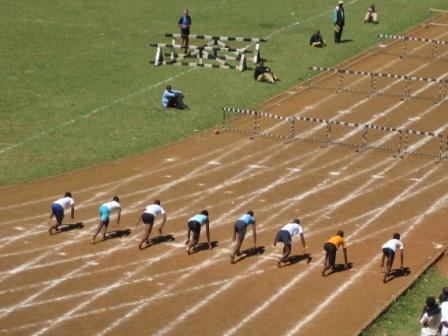
In the past two days we saw two school meets: a primary school meet and a secondary school meet.  As the Ellensburg Track teams have districts, regionals, and state, I thought it would be interesting to share my impressions of meets on the other side of the world.
The primary school meet was held at Uhuru and Apollo’s school, Salaba Academy.  About 3 other primary schools attended.  The event began at 11:00.  Classes were held until about 10:30.  Primary school means standard 1-8, which is the same as grades 1-8.  However, especially at public schools, there are many students who are “old” for their grade.  It can be hard for families to raise school fees, and sometimes children stay at home to work.  One of Apollo’s friends, Alan, is 13 and is in 5th grade.  Some of the primary school students from other schools looked to be almost 18!
The teachers had painted lane lines around a grassy field.  The field wasn’t quite large enough for a 400m track, so it was perhaps 350m.  The field, which is also used for soccer, has a distinctly uphill side.  The surface is fairly uneven.  The 100m was held on the uphill portion of the track.
The girls 3000m began with a mad dash for the first lap.  Soon, students began dropping out.  About half the field dropped out!  As in all the races, only one or two students wore shoes, and all the students wore their school uniforms.  The girl who won took of a sweater with about a lap to go.  I didn’t catch her time (and of course I’m not sure about the distance), but she looked like she would make the Ellensburg varsity cross country team.
Boys run the uphill side of the track during the 800m at the primary school meet.
In the boys 3000m a young man with shoes, running shorts, and a hi-tech shirt sprinted to the front.  He was absolutely flying.  Although he slowed during the race, he still lapped nearly the entire field.  He looked to be much older than the other boys, and some of the teachers said he was training already.  He also won the 800m later.  It was good that Apollo didn’t run; it would be like an 8 year old entering a high school race!
The hurdling kung fu high jump technique.  When you have to land on your feet.
The equipment for the field events was different than in the U.S.  The javelin was a sharpened stick.  I saw one of the officials get hit with it.  Fortunately he was not hurt.  The shot put was a large brick.  The discus was a flat slab of concrete.  The high jump was amazing to watch.  The landing was dirt which was harder that the long jump sand.  Students had to land feet first.  Still, they would run full bore and leap, lifting their feet up in a kung-fu-esque maneuver and clear the stick.  They were jumping over 5 feet with this technique!
Tambach Track
The secondary school meet was much better equipped.  This event was the Rift Valley Junior Championships.  It was held at Tambach Teacher’s College, about 10km from Iten and at a lower (but still over a mile high) altitude.  The Tambach track, although still dirt, is a 400m track and the surface is in significantly better shape than Kamariny in Iten.  It's a little strange to explain that there are two all weather tracks in Ellensburg, the same number as in the entire country of Kenya.  Brother Colm used to bring his elite athletes (including 800m world record holder David Rudisha) there to train, but rumor has it that the track is not open to the public for training.  There were actual javelins and a pole vault with mats (still a lot less mat than you’d see in the U.S.).
The wide range of athletes struck me.  There were athletes wearing their school uniform, which for girls meant a skirt.  Several athletes were barefoot.  There were also athletes with Kenya national team jerseys and the newest spikes.  These athletes had represented Kenya internationally, at world junior championships or African championships.  None of the athletes had school athletic uniforms; they wore whatever they had.  Numbers were handwritten on pieces of paper and stapled to their jersey.
Girls 110m Hurdles.  Only one athlete has shoes.
 The girls’ 3000m steeplechase was crazy to watch.  The first time over the water jump almost all the girls hurdled the rail and landed in the deepest part of the water.  They struggled out of the water, many falling and crawling out.  By the third lap they had all figured it out and were sailing over the water jump.  A friend pointed out that they might not have had access to a water jump to practice.  The winner ran 10:31; 3000m steeplechase times are roughly comparable to 2-mile times.
In the boys’ steeplechase one boy, barefooted and wearing the long shorts and button down shirt of his school uniform, was off the back the first lap.  As he approached the chaos of the water jump, he turned around and jogged off the track.  There was laughter and shouts from the crowd.  In the U.S. this kind of laughter would be seen as mocking and cruel.  I’ve learned that the Kenyans view this as laughing with you, not at you. 
Lead boys clear the water jump.
 The top boys, meanwhile, were flying.  Three boys formed a lead group, with one boy chasing a few seconds behind.  The winner broke away with 600m to go and ran 8:41, which remember, is roughly comparable to a 2-mile time.  He was of course, wearing a Kenya jersey.  I didn’t catch his name, but perhaps by the 2016 Olympics we’ll all know it.
Boys 800m.  Note stapled on paper numbers.
The boys 800m was won in 1:49; the girls in 2:13.  The relays tags were a little shaky, but still the 4x400m was run in 3:13 by the boys and 3:58 by the girls.  The second place girls team, all wearing skirts, ran 4:03.  Overall the secondary school meet was a very high level meet, but still there was a huge discrepancy between the future national team stars and those bringing up the rear.
Good luck to the Ellensburg Team in your upcoming school meets!

Thursday, May 12, 2011

Running with (well, at least closer to) the Kenyans

Today was a big breakthrough day for me.  For about the past seven Thursdays I’ve been going to the group fartlek run.  “Fartlek” is Swedish for “speed play” and the Kenyan fartlek is usually one minute hard followed by one minute moderate or two minutes hard followed by one minute moderate, repeated for 30-60 minutes total.  To add to the challenge the run is mostly uphill.  It is a hard run for all.  Usually I see the lead group for about 10 minutes, and then run with a goup of women and some straggling men.
There were over 100 runners at the workout today.  I love the energy of running with so many people.  It’s quite congested at the beginning, but things clear up within about 3 minutes.  Wilson Kipsang, who ran 2:04:57 for the marathon last fall (that’s 4:46 per mile, folks!), is the leader of the group.  He said we would be doing 25x1:1, and counted down so we could synchronize our watches.
I wasn’t feeling particularly good during my 30 minute warm-up, and as usual I started the workout near the back of the group.  I had a goal of 15x 1:1, and I wanted to finish on an uphill section a little higher than I’d gone before.  After about 5 minutes I caught up to Carol, who I have run the last two fartleks with.  I was surprised that I was running quite a bit faster than her.
I kept catching up with people, including several men.  At about 15 minutes I realized with surprise that I could still see the leaders.  Yes they were about a minute ahead of me, but I could see them!  There were about 40 people in a tight group, followed by smaller groups and individuals who had fallen off the pace.
We reached an intersection at about 25 minutes.  In an earlier workout I remember wondering which way the leaders had gone.  But this time I could still see them.  As we climbed the hill I was planning to finish on, I saw the leaders and checked my watch: 28 minutes.  I arrived at that spot less than 2 minutes later.  I was so jazzed I decided to do two more, so I finished at 34 minutes.  I caught up to a group of men who had been with the leaders but finished their workout at 30 minutes; they were cooling down.  About two and a half miles of easy jogging brought me back home.
Now, I still think it’s a distinct possibility that the group’s pace was lower than it has been in previous weeks.  And it’s probably a good bet that the people in the lead group were running a lot easier than me.  And of course, most of them ran for 50 minutes, while I stopped at 34.  However, it was great to be in sight of the group of world class runners on a hard run.  I was almost running with the Kenyans!

Wednesday, May 11, 2011

A Visit to Rashid's Place in the Tugen Hills

On Monday Anders, Isak, Paul and I rode the morning matatu to visit Rashid’s house.  Rashid is my neighbor in Iten.  He is hoping to go to college in the U.S., and I’ve been helping him prepare for the SAT and contact coaches.  He took the SAT in Nairobi on Saturday and then went home for a few days.  He invited me to come visit him.
Rashid met us in the city of Kabarnet, about an hour from Iten.  We had to travel about 8km farther to the turnoff to Rashid’s village, Kapkemoi.  We rode in a van that was filled with flour, baking powder, and oil.  The van stopped to unload all the food.  After being told this was a bakery, I bought a bag of “Rock Cakes,” which were actually a hard roll that was still warm from the oven.  Despite the name they were quite good.
We got out of the van shortly afterward at the turnoff for Kapkemoi.  Rashid, Anders and I would run, while Isak and Paul would walk to the village, 3km away.  The running was quite different from Iten.  First of all, it was seriously hilly.  Second, the area is much more sparsely populated.  We passed mostly through forest.  Our route, which was part of former marathon world record holder Paul Tergat’s standard runs, passed Rashid’s village and descended to another village.  We turned and climbed back towards Kapkemoi.
Rashid took this picture after dashing by.
Rashid pointed out a sudden left turn up a very steep hill.  We were climbing Morop, one of the more prominent hills in the Tugen Hills.  The climb was much like Manastash Ridge, but without the moderate parts and at 7000 ft.  Rashid, who is much faster than either Anders or me, bounded ahead, took pictures as we passed, bounded ahead again, and repeated this several times.  I was breathing hard as it was a struggle to remain running, especially near the top where there is a scrambling section.  Near the top I was stung by a bee on my left hamstring.
Lake Baringo from Morop
The view from the top was spectacular.  The Tugen Hills are between the two branches of the Rift Valley.  Morop, one of the highest points in the Tugen Hills, has panoramic views of both branches of the valley and the opposite sides.  The Tugen Hills themselves are quite rugged.  Rashid pointed out the villages of two of the fastest marathoners of all time: Geoffrey Muthai (2:03:02 2011 Boston) and Paul Tergat (2:04:55 2003 Berlin).  Rashid also outlined some of Tergat’s training routes.
Kapkemoi village in the foreground from Morop
We ran carefully down the hill, and we met Isak and Paul back in Kapkemoi after about 65 minutes of running.  Kapkemoi is a tiny town.  The road is rough, and only few vehicles pass by each day.  Kapkemoi is not on the electric grid.  It is an idyllic little town, slightly lower than Iten.  Bannanas, Mangoes and Papaya grew in the farms.  We all walked down the hill past Kapkemoi Primary school, where the kids flooded out of the buildings at the sight of us white people.  Rashid said that they might not have ever seen a white person before.
I told you it was idyllic!  Note banana trees as well.
We arrived at Rashid’s “younger father’s” house.  This was the house of his father’s younger brother.  Rashid grew up here.  His mother died when he was about 8.  Rashid’s uncle is an army officer so has a very nice house which includes a solar panel.  Kristin, Rashid’s aunt, served us chai and a delicious lunch of beans and rice.  We relaxed for a while, and then took some pictures when Rashid’s cousins came home from school.
Rashid, his cousins, and aunt
It was time to head home, and we opted to cross Kirandich Dam.  The reservoir was built by the Italians in the 1990s.  This is the source of Kabarnet Spring water, which is sold widely in Kenya.  A solid climb took us to the paved road, where we got a car to Kabarnet, and then a matatu home in time for dinner.

Tuesday, May 10, 2011

New Arrivals

We have two new people in our place in Iten: Isak and Paul Bergman.  Isak ran at Ellensburg High School and graduated in 2007; he is the school record holder in the 800m and 1600m.  I had heard that he was interested in getting back into training before I came to Kenya.  As soon as I arrived, I thought “Isak would love this place!”  A lengthy email exchange ensued, and last Friday Isak arrived here after two days of travel from Ellensburg.  Isak has been immersing himself in the running culture, meeting many runners and beginning his own training.  He is the ultimate friendly mzungu, taking the time to talk to everyone he sees.
Accompanying Isak is his uncle Paul.  I had met Paul once before when I stayed at his house before the Portland Marathon in 2007.  Paul is inquisitive and thoughtful; in the car ride from the airport he was already asking questions that I not only couldn’t answer, but hadn’t even thought to ask.
The first few days of a 10 hour time change are pretty rough, but Isak and Paul have been much more upbeat than I remember being!  Paul is here for two weeks, and Isak is here for four.  We’re looking forward to sharing many adventures together.